 Talkfirst
Short answer. Ask the agent to set your level, goal and deadline in your Talkfirst profile and to agree a weekly plan with you: minutes of your own speech, quizzes, conversations and lessons. The server counts what you actually did each week, so in every new chat the agent sees plan and fact side by side and can adjust the next week.
Ask ChatGPT for “a 3-month plan to reach B2” and you'll get a neat table in a few seconds. The trouble starts later. The plan lives in one chat, a new chat doesn't know it exists, and nobody counts what you did on Tuesday. After two weeks the table no longer matches your life, and there is nothing to adjust it against.
With Talkfirst connected, the plan and the fact are stored in your account. How to connect is in the section overview; here is the plan block in detail.
Start with the profile
The plan only makes sense against a goal. Your profile (profile) holds:
- your level, as a self-assessment from A1 to C2;
- your goal: work, with your profession, or life: travel, moving abroad, socialising, films and media;
- a few lines about you;
- a target level and a deadline.
My level is about B1. I work as a project manager and need English for meetings with clients. I want to reach B2 by 1 March. Save that to my profile.
The agent writes it down and confirms. From now on every new chat starts from this.
A weekly plan, not a daily timetable
The plan (plan, plan_set) is a set of weeks, up to 12 weeks ahead; each week starts on Monday. A week has a focus, a short line of up to 300 characters, and targets in things the server can count by itself:
- minutes of your own speech;
- quizzes;
- conversations;
- lessons completed.
The server fills in the fact for the current and past weeks. So when you open a new chat, the agent sees both: what you planned and what actually happened.
Days inside a week are not stored. “Quizzes on the commute, a conversation on Saturday” is something you agree in the chat; if it's a standing arrangement, the agent can offer to keep it in your notes. And the agent always agrees the plan with you before it writes it.
Make a four-week plan. I have 15 minutes on weekdays and more time on Saturday. Week one focus: answering questions about my work experience. Show me the plan before you save it.
This week is busy. Cut the plan in half and keep the conversations.
What a first month can look like
A plan works better when each week has one clear focus tied to your goal. For a project manager preparing for interviews and client calls, four focus lines might be:
- talking about my work experience;
- interview questions: strengths and weaknesses, a job offer;
- small talk with colleagues: catch up with someone, get along with;
- negotiating: negotiate a salary, meet halfway.
The targets for each week you set with the agent from your real time and your voice limit, not from an ideal. The focus line also tells the agent which words, lessons and conversations to suggest that week.
Plan against fact
The point of a counted plan is the weekly look back. Ask the agent at the start of a new week:
How did last week go against the plan? What should we change for this week?
The agent compares targets with the fact the server counted and suggests the next week. If you planned three conversations and had one, the answer may be fewer conversations and more short quizzes, not a guilty feeling.
For a wider picture there is progress for a number of days: flashcards and reviews, activity by source and your latest pronunciation attempts.
Show my progress for the last 14 days. Where did most of my practice come from?
Pace: are you on track for the deadline?
Once you have a target level and a deadline, Talkfirst estimates your pace. It is a rough estimate of how many minutes of your own speech per week you'd need to reach the target level by the date, how many you are doing now, and whether the weekly voice limit of your tariff is enough for it. The first two weeks after you set the goal are calibration, and the numbers are approximate on purpose.
The agent talks about pace only from this estimate, not from its own guesses. It won't promise “B2 in eight weeks”, and you shouldn't believe anyone who does.
What's my pace to B2? Is my plan enough, or do I need more speaking?
On Free, keep in mind that the 35 voice minutes a week cover both recognising your speech and voicing answers; the pace estimate tells you whether the plan fits.
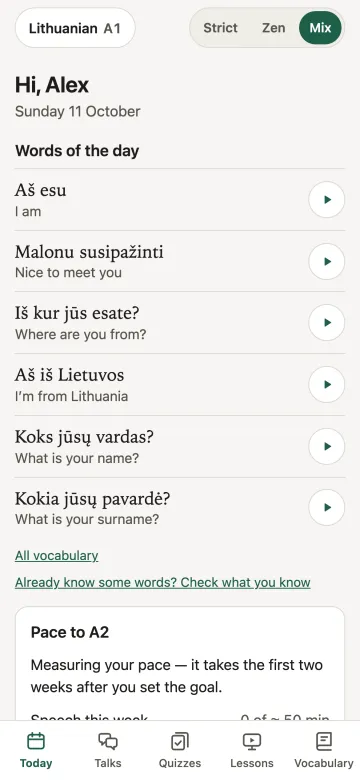
The Today screen of the app in Telegram, here on the Lithuanian course; the pace card at the bottom looks the same for English.
A plan that bends
A study plan for adults fails for one reason more than any other: life. A trip, a deadline at work, a sick child. A counted plan helps here too, because the agent sees the gap and can rebuild the next week around it instead of pretending nothing happened.
I'm travelling next week and will only have my phone. Make next week short: quizzes and one lesson I can listen to.
Quizzes and lessons work in Telegram on the phone; the voice limit and plan stay the same. More on that in the app that works with your AI. Other guides are in the English guides; the product is on the Talkfirst home page.
Questions
Can ChatGPT make me an English study plan?
It can write one, and a good one. What a plain chat can't do is keep it between chats and count what you did. With Talkfirst the plan and the fact are stored in your account, and the agent sees both in every new chat.
How long will it take me to reach B2?
Nobody can honestly promise a number of weeks. Talkfirst gives a rough pace estimate: how many minutes of speech a week you'd need for your target level by your date, and how many you do now. The first two weeks are calibration.
Does the plan say what to do each day?
No, the plan is weekly. Days are agreed in the chat, and a standing arrangement can go into your notes for the agent.
What counts as speaking time?
Minutes of your own speech that Talkfirst recognised in your English course. The server counts them itself; the agent doesn't fill them in by hand.