 Talkfirst
Short answer. For conversation and explanations a plain ChatGPT or Claude is already very good, and with clear prompts its corrections become consistent. What it lacks is a record: what you learned, when to review it, how you actually sound and where you pause. The setup we recommend is your own agent plus Talkfirst: the agent thinks and explains, Talkfirst stores, listens and delivers.
People searching for “the best AI app to learn English” usually compare apps with each other. We'd suggest a different question: what do you already have, and what is it missing? Most people already have ChatGPT or Claude. We make Talkfirst, so we'll say plainly what the plain chat does better than any app.
What a plain chat does well
- A partner on any topic. A job interview, small talk with a colleague, a complaint about a faulty laptop: it plays any role at any level.
- Explanations. Why it's the Present Perfect here and not the Past Simple, how hand in your notice differs from hand in your resignation, in plain words and with as many examples as you want.
- Rephrasing. You write it your way, and it shows how a colleague or a client would say it, from formal to relaxed.
- Role-play. A negotiation where the other side won't move, a landlord who won't return the deposit.
- Voice mode. You can talk out loud instead of typing.
This is real value, and Talkfirst doesn't try to replace it. Prompts that get the most out of it are in English with ChatGPT and Claude.
What it lacks
A memory that works as a record
ChatGPT and Claude have memory, but it holds notes about you, not a log of what you learned and when to review it. A new chat starts almost from scratch, and in a long chat the early messages drop out. The list of twelve interview phrases from last Tuesday is somewhere in your history, not in front of you.
Hearing how you really sound
Voice mode tries to understand you, not to grade you. It answers the meaning it understood and doesn't show the pauses, hesitations and words it had to guess. Mistakes in sounds and long pauses before hard words stay unnoticed, and there is no score for each word.
Consistent corrections
Without rules in the prompt the assistant either corrects every small thing or nothing at all. A prompt fixes that inside one chat, but you have to bring it to every new one.
What Talkfirst gives your agent
Talkfirst connects to Claude and ChatGPT as an MCP connector. It doesn't make the agent smarter. It gives it material to be smart about: your learning laid out as cases.
- Your pauses by word timing: where you stopped for 0.4 seconds or more, and before which word.
- Corrections and “Say it better” versions from your conversations, in their context.
- Your weak words and response times: which words you answer slowly and in which skill.
- The history of quizzes and conversations.
- Profile, notes and plan: a knowledge base about you that the agent reads at the start of every new chat.
- A vocabulary you can throw words into, which turns them into flashcards and quizzes.
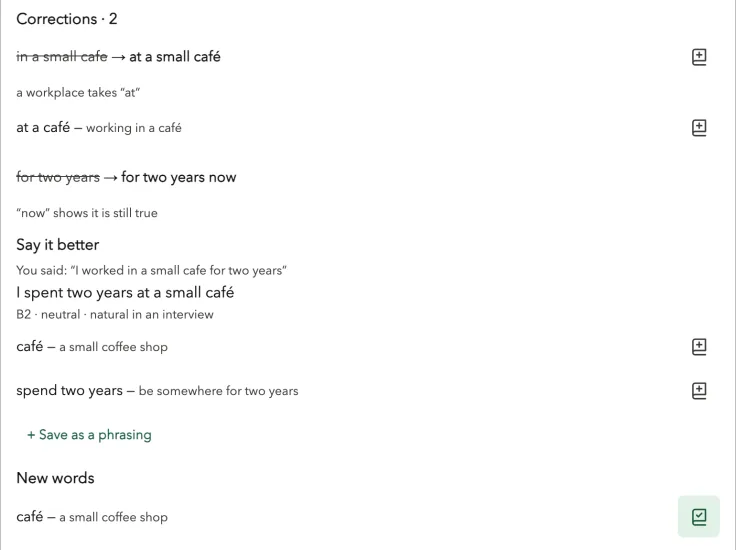
Feedback after a conversation, the kind of material your agent reads. A frame from our test setup, not a screenshot of a live chat.
And there are things that take an agent a long time to put together on its own: English decks by topic and level from A1 to C1, conversation scenes with a voice partner, a pronunciation window with word scores. All of this also works without the agent, in the app in the browser and in Telegram. There are no ready-made English lessons or mock exams; lessons are built by your agent on request.
Three setups side by side
A plain chat
Good if you want to talk and ask questions now and then. Costs nothing extra. Words fade, and you don't know how you sound.
A chat with good prompts
Good if you're disciplined: you keep the word list yourself, paste it in each time and bring your rules to every chat. Corrections become consistent; reviews and a pronunciation score are still missing.
Your agent with Talkfirst
Good if you want to learn steadily over months. The agent stays the same, and it gets a record of you, a voice that can be measured and a place where lessons and words wait for you on the phone.
Prompts that show the difference
Try these in a new chat with Talkfirst connected. In a plain chat they have nothing to work with.
What should I review today?
Look at my last conversation. Where did I pause, and before which words?
Which of my words do I answer slowest? Let's practise three of them out loud.
Build today's conversation around the corrections from last time.
The agent answers from today, dialogue_result, word_stats and your vocabulary, not from memory of a past chat.
And other apps?
If you are comparing ready-made speaking apps such as ChatGPT voice mode, Talkpal or a live tutor, we've done that separately in AI speaking partners compared. How the whole method works is in the section overview. More guides are in the English guides; the product is on the Talkfirst home page.
Questions
What is the best AI app to learn English?
For conversation and explanations, the agent you already have: ChatGPT or Claude. For keeping words, measuring pronunciation and counting progress, add a connector such as Talkfirst. Together they cover more than either does alone.
Is Talkfirst smarter than ChatGPT?
No, and it doesn't try to be. The agent thinks and explains; Talkfirst stores your words, listens to your voice, counts your progress and delivers lessons and quizzes to your phone.
Can I use Talkfirst without an agent?
Yes. Decks, quizzes, voice conversations with feedback and lessons you already have work in the browser and in Telegram. Without the agent you lose the explanations and words picked for your situation.
Is it free?
Free includes 35 voice minutes a week, 210 new voicings and the starter scenes. Pro has 140 voice minutes a week, all scenes and your own topic, for 500 Telegram Stars for 30 days.