 Talkfirst
Short answer. With the Talkfirst connector, the agent saves your goal, level and deadline in your profile and writes a weekly plan up to 12 weeks ahead with plan_set. Each week has a focus and targets — minutes of your own speech, quizzes, conversations, lessons — and the server counts what you actually did, so in a new chat the agent sees plan and fact side by side.
Ask an AI chat for “a plan to learn Polish in three months” and you'll get a tidy table: week one, greetings and numbers; week two, the past tense. It looks convincing and is forgotten by Thursday. A new chat doesn't remember the table, and nobody counts whether you did any of it.
With the Talkfirst connector the plan becomes data: it's stored with your account, the server fills in what you actually did, and the agent reads both at the start of every session. How to connect it — in the section hub.
Start with the profile
A plan is only as good as what it's planned for. The profile (profile) holds:
- your level — a self-assessment from A1 to C2;
- your goal: work (with your profession) or life — travel, moving, everyday talk, media, an exam;
- a free-text “about me”;
- a target level and a deadline.
Let's set up my profile. I'm around A2 in Polish, I work as a nurse in Kraków, and I want B1 for long-term residence by next September. Ask me what else you need.
The agent asks the rest and saves it. If the goal is the B1 exam, how that exam works is in Polish B1 for long-term EU residence; the oral topics are in Polish B1 oral exam topics.
Notes: how you want to be taught
Separate from the plan, there are notes (notes, notes_set) — your standing wishes for the tutor, up to 2000 characters. “Correct me after the conversation, not during it.” “Always use Pan/Pani in office scenes.” “My appointment at the voivodeship office is on 14 March.” When you say something like that, the agent offers to save it.
Remember for every session: explain grammar briefly, with one example; correct my endings after we finish talking, not mid-sentence.
The weekly plan
plan_set writes a plan of up to 12 weeks ahead; each week starts on Monday. A week has a focus — up to 300 characters, for example “at the office: queue number, form, signature” — and targets that the server counts by itself:
- minutes of your own speech (
speech_min) — what you said out loud, not how long the app was open; - quizzes;
- conversations;
- lessons completed.
The actual numbers for the current and past weeks are filled in by the server. You don't report “I did 20 minutes”; the agent sees it in plan(). Days inside the week aren't stored — you agree them in the conversation (“conversations on Tuesday and Thursday, a lesson on the tram on Friday”).
The agent agrees the plan with you before writing it. That's the right order: a plan you didn't agree to is a plan you won't follow.
Make a 4-week Polish plan for me toward the B1 oral part. Week 1 focus: the office and documents. Then work, housing, opinions. Show me the targets for each week before you save it.
It's Monday. Show me last week's plan against what I actually did, and adjust this week if I fell behind.
Pace: an honest estimate, not a promise
Once you have a target level and a date, Talkfirst estimates the pace (pace): roughly how many minutes of speech a week you need to reach the level by the date, how many you're doing now, and whether that fits the voice limit of your plan. The first two weeks after setting the goal are calibration — there's not enough data yet, and the card on the Today screen says so.
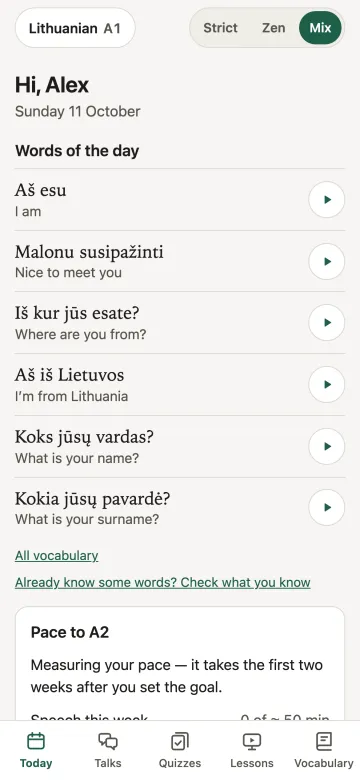
The Today screen of the app in Telegram, on the Lithuanian course. The pace card looks the same for Polish.
The numbers are rough — “about” — and the agent talks about pace only from this field. It won't tell you “B1 in 10 weeks”: the estimate shows the direction, not a guarantee.
Am I on pace for my goal? If not, what's the smallest change to my week that would help?
Checking in: progress
progress(days) gives the agent the bigger picture: flashcards and reviews, activity by source (conversations, quizzes, pronunciation, lessons), your latest pronunciation attempts. Useful for a monthly look back.
Look at my last 30 days in Polish. What did I do most, what did I skip, and what should next week's focus be?
Where the mock exam fits
If you're working toward the B1 exam, the mock oral B1 exam in the app's exams tab is a good checkpoint. On Free, one full mock exam of each kind is available once every 7 days. A reasonable rhythm: one mock at the start to see where you are, then one every few weeks, with the plan's focus adjusted after each.
I did the mock oral B1 exam today. Plan the next two weeks around the parts where I was weakest.
Everything in the plan — conversations, quizzes, lessons — happens in the same account, in the chat or in the app. How the app fits into the week is in the app where it all lives. All guides — Polish guides.
Questions
Can ChatGPT or Claude make a Polish study plan?
A plain chat can write one, but won't remember it or check it. With Talkfirst connected, the plan is saved with your account, the server counts what you did, and the agent sees plan and fact in every new chat.
How far ahead can the plan go?
Up to 12 weeks, week by week from Monday. Each week has a focus and targets; days inside the week are agreed in the conversation.
Will the agent tell me when I will reach B1?
No. It shows a rough pace: how many minutes of speech a week your goal needs and how many you are doing. The first two weeks are calibration, and the numbers are estimates.
Does the plan count time I spend in the app?
Yes, conversations, quizzes and lessons in the app and in the chat count toward the same targets, because it's one account.