 Talkfirst
Short answer. With the Talkfirst connector, Claude opens a recording window right in the chat: you hear a reference, say the Polish phrase and get an overall score out of 100 plus a score for every word. The agent then explains one or two main mistakes in English. It is word-level scoring from speech recognition, not an analysis of individual sounds or intonation.
Ask an AI chat “how do I pronounce Szukam czegoś taniego?” and you'll get a careful explanation of sz, cz and ś. What you won't get is a check of how you said it. Voice mode tries to understand you, not to grade you: it will understand a phrase with a wrong sound and move on.
The Talkfirst connector gives the agent ears it can use as data: a recording window, a score per word and the timing of your words. How to connect it — in the section hub.
The pronunciation window
When you ask for pronunciation practice, the agent calls practice_phrase, and a window opens right in the chat (Claude on the web or the desktop app). In it: a button to hear the reference (in the frame below it's called Reference) and a Record button. Three ways to call it:
- without arguments — the next phrase from your deck;
- with
text— any phrase, for example one from your own email; - with
card_id— a specific flashcard.
Give me a pronunciation window for the phrase “Gdzie mam wysiąść?” — I need it on the bus tomorrow.
Let's practise pronunciation on my flashcards for today, one phrase at a time.
What the result shows
After the recording the window shows an overall score out of 100 and a score for each word. A word that came out imprecisely is highlighted with its own score. Below it, “Heard: …” — what speech recognition actually heard — and your reaction time.
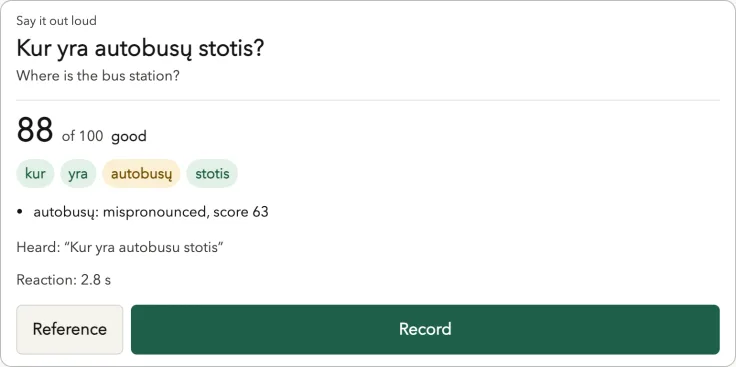
The pronunciation window on the Lithuanian course: a frame from our test setup, not a screenshot of a live chat. The window for Polish is the same.
The “Heard” line is often the most useful part. If you said Dziękuję, miłego dnia. and the Heard line shows a different word, you know which word to work on.
Be clear about what this is: a score from speech recognition at the level of words. It doesn't break down individual sounds and doesn't grade intonation. Scores are automatic and can be wrong, and the reference voices are speech synthesis. For a lot of practice, that's enough; for fixing a stubborn sound from scratch, a teacher is still better.
What the agent does with the score
The window sends the result back to the chat itself. The agent reads it and explains one or two main mistakes in plain English — not a list of everything, just what matters most. If your speech wasn't recognised as Polish, there's no score, and the agent asks you to record again.
I keep getting a low score on “Mam rezerwację na dziewiętnastą”. Which word is the problem, and how do I say it? Then give me the window again.
Polish has a few spots where almost everyone stumbles: sz against ś, cz against ć, rz and ż, the nasal ą and ę. Phrases from the decks that hit them: Proszę wziąć głęboki oddech. (at the doctor's), Gdzie jest wejście? (delivery), Skrzyżowanie (asking the way).
Pick 5 phrases from my vocabulary that have sz, ś, cz or ć, and give me pronunciation windows for them one by one.
Recall mode: say it from memory
Repeating after a reference trains your mouth. Saying a phrase from memory trains what you actually need at the office window. With recall=true the window shows only the translation — say, “Where should I sign?” — you say the Polish from memory, and the original opens after the recording.
Pronunciation in recall mode: show me only the English and I'll say the Polish. Start with my office phrases.
After such an attempt the agent counts the flashcard with the suggested grade (srs_review), so recall practice moves your spaced repetition forward too. Flashcards and quizzes in more detail — in Polish words with an AI agent.
For several phrases at once there's quiz_start(type="say"): you see the translations and answer out loud. At the end you get, for each phrase, whether it was recognised, the score, the reaction time and a hint when a phrase can be marked as known.
A “say it in Polish” quiz on 8 phrases from the A1 café deck.
Pauses in conversation
Pronunciation isn't only sounds. In a voice conversation, speech recognition returns the time of every word. A pause of 0.4 seconds or more between words is recorded, along with the word it came before, and so is the “thinking time” before your first word.
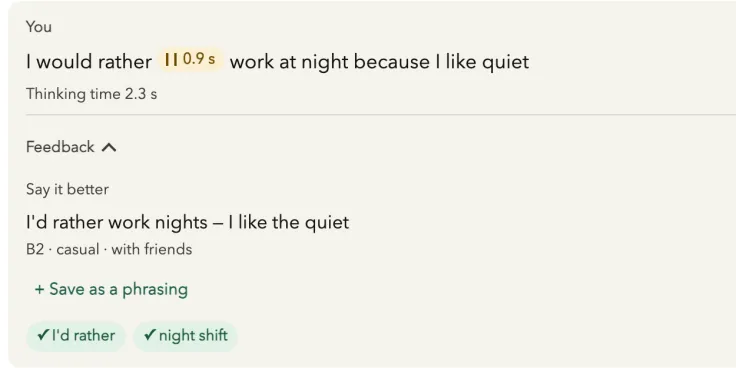
A reply in a conversation on the English course, a frame from our test setup. Pauses in Polish conversations are marked the same way.
Words you often hesitate before end up in today(), and the conversation partner weaves them into your next conversations. If you keep stopping before zaświadczenie, expect to meet it again soon.
Look at my pauses from this week's conversations. Before which Polish words do I hesitate most?
On the phone
In the Claude mobile apps the connector's windows have no microphone. Text tools work there, but record in the Talkfirst app — in the browser or in Telegram. The window itself suggests “Open in browser”. When you've recorded in the app, write “done” in the chat, and the agent takes the result from progress.
The mock oral B1 exam is in the app's exams tab — what the exam itself looks like is in Polish B1 for long-term EU residence. More guides — Polish guides.
Questions
Can AI check my Polish pronunciation?
Yes, at the level of words: Talkfirst gives an overall score and a score for each word from speech recognition, and shows what it heard. It doesn't analyse individual sounds or intonation.
Does it work in the Claude mobile app?
The windows in the Claude mobile apps have no microphone. Record in the Talkfirst app in the browser or Telegram and tell the agent you're done; it will pick up the result.
What if the score seems wrong?
It can be: scores are automatic. Listen to the reference again, check the Heard line and record once more. If the problem repeats, ask the agent to explain the word in detail.
Which voice do the reference recordings use?
Speech synthesis, not a recorded native speaker. It's a clear model to repeat after, but it's still a synthesised voice.