 Talkfirst
Short answer. Connect Talkfirst to Claude or ChatGPT and ask the agent to save Polish words: it writes them with a translation and an example into your vocabulary and flashcards, skipping duplicates. Then it knows what to review today, builds quizzes from your words and sees which ones you still recall slowly.
People ask ChatGPT for “20 Polish words for the office”, get a neat list and lose it a week later in the chat history. The list was fine; the problem is that nothing happens to it afterwards. A word you met once fades unless it comes back after a day, three days, a week.
With the Talkfirst connector the agent has somewhere to put words: a vocabulary that is also your flashcard deck. It's the same vocabulary you see in the web app and in Telegram. This article is about filling it well. How to connect the connector — in the section hub.
What happens when you say “save this word”
The agent calls vocab_add. One call takes up to 200 entries, and each has a few fields: term — the Polish word or phrase, meaning — the translation into the language you study in (English here), example — a sentence, level and kind. Everything goes into the vocabulary and into flashcards at once. If a word is already there, it's skipped, so you can repeat yourself without creating duplicates.
There are two kinds of entries, and the difference matters:
- chunk — a word or an expression of up to about five words: karta pobytu (residence card), złożyć wniosek (submit an application), Gdzie mam podpisać? (Where should I sign?). Chunks go into quizzes and flashcards.
- formulation — a whole ready-made sentence you want to be able to say, for example Muszę umówić się na wizytę w urzędzie. It doesn't go into quizzes; instead, the partner in a voice conversation creates an occasion for you to say it.
Rules the agent follows
Before adding words the agent reads docs("vocab"), and the rules there are short:
- One entry is one word in its dictionary form or one whole phrase. If you said Chcę złożyć wniosek o kartę pobytu., the entry is karta pobytu, and the form kartę stays in the example. Polish cases change endings all the time; a dictionary form plus a real example is what you need to recognise the word later.
- Lists are split. “Umowa, wynagrodzenie, urlop” is three entries, not one.
- A grammar rule is not an entry. “Accusative after mam” belongs in an explanation or a lesson, not in the flashcards.
Where to get words from
From your own text
The best words are the ones from your life: an email from the landlord, a message from a colleague, a letter from the voivodeship office.
Here's an email from my landlord in Polish. Pull out 10 words and phrases I'll need to reply, at A2 level, and save them to my vocabulary with an English translation and an example from the text. Text: …
The agent picks the words, shows you the list and calls vocab_add. Look over the list before saving: you know better which words you actually need.
From a situation
Next week I have a job interview in Polish. Save 12 phrases I'll need — things like “job interview”, “work experience”, “cover letter” — as chunks, plus 3 whole sentences about my experience as formulations.
Here you'd expect entries like rozmowa kwalifikacyjna, doświadczenie zawodowe, list motywacyjny — they're in the course's B1 job-search deck too.
From the course decks
Talkfirst has Polish decks by topic and level: the courier at the door, the office queue, the doctor, renting a flat, false friends. The agent sees the list with topics().
Which Polish topics do you have at A2? Make me a quiz on the “At a Polish Office” topic, then go through that deck with me and mark what I already know.
The agent starts quiz_start with the topic as the source, then runs calibrate over the deck. That deck has wziąć numerek (to take a queue number), Proszę wypełnić formularz. (Please fill out the form.) and zaświadczenie (certificate).
From a conversation review
After a voice conversation the review shows your corrections and “Say it better” — a more natural way to say what you meant. Each correction and phrase has a “+” button that sends it to your vocabulary.
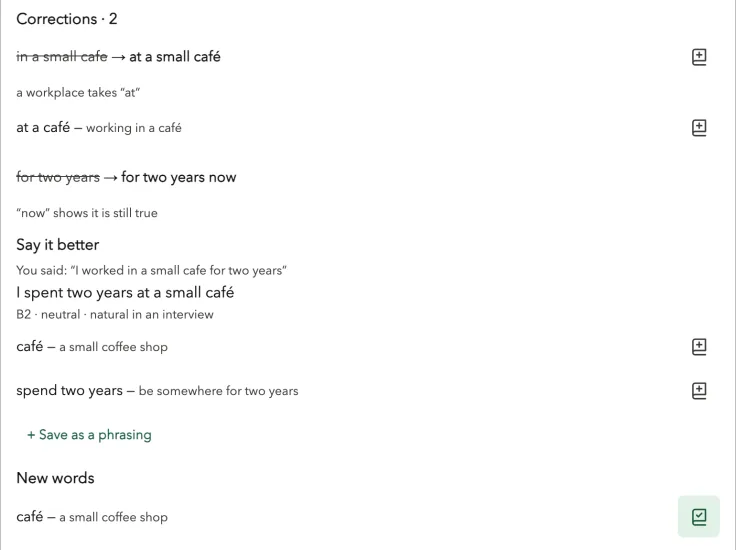
A conversation review on the English course, a frame from our test setup, not a screenshot of a live chat. The review for Polish works the same way.
The app itself has no “add your own word” button: your own words get into the vocabulary through the agent or from a conversation review. In the app you see the whole vocabulary in the Vocabulary tab and can remove a word.
Review: flashcards and quizzes
Saving words is half the job. The other half is bringing them back on time. The agent sees the flashcards due today (srs_due) and records your answers (srs_review), so the spacing is kept by the server, not by your memory of what you did last Tuesday.
What Polish words are due today? Go through them with me, one at a time.
For a quiz the agent calls quiz_start. Types: recognise (Polish → English), recall (English → Polish), listening, saying it out loud, and “say it in Polish” — you see the translation and answer by voice from memory. The source can be words due for review, weak words, new ones, a topic, or an exact list.
Make a quiz on the words I got wrong this week: recall and listening, 10 questions. Then repeat only the mistakes.
Repeating only the mistakes is only_wrong; a quiz you like can be saved (quiz_save) and run again from the list (quizzes).
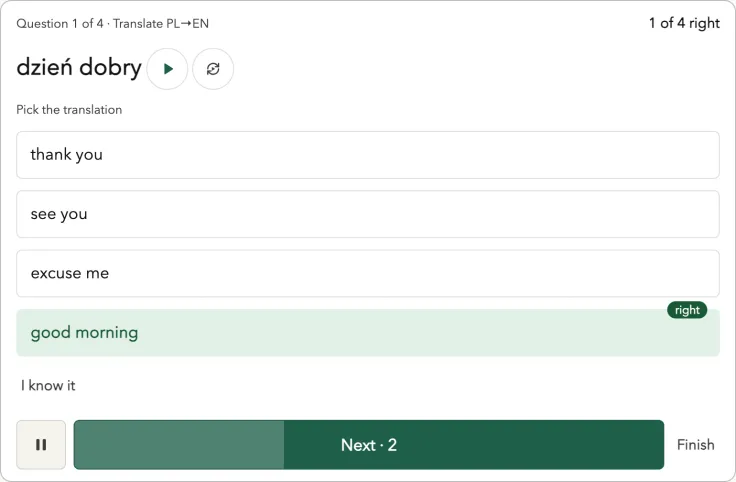
The quiz window on Polish words. A frame from our test setup with the interface in English, not a screenshot of a live chat.
Words you already know, or don't want
Ukrainian and Russian speakers often recognise a lot of Polish on day one, and English speakers who've lived in Poland for a while know more than any placement test expects. Don't drill those words again:
- “I already know this” —
mark_known, with five levels: I recognise it, I recall it, I get it by ear, I can pronounce it, I use it. - “Not now” —
defer_card; “don't teach me this at all” —skip_card. calibrate— the agent goes through a list with you and sorts it.
Go through the A1 “Delivery and taxi” deck with me and mark what I already know. I'll answer quickly: know / don't know.
Seeing how a word is going
word_stats shows a word's status, its skills from 0 to 2 and the median response time for each. If you recognise umowa instantly but need four seconds to recall it, that's a reason to talk about it, not a verdict. vocab_list filters the vocabulary, for example: “words I still don't recall confidently”.
Show me the Polish words I still don't recall confidently, and make a short quiz from the five slowest.
The app has three modes: Strict, Zen and Mix. Zen is review without pressure — for days when you want to keep the habit, not test yourself.
Pronunciation of these words — in pronunciation with an AI agent. All the other guides — Polish guides.
Questions
Can ChatGPT make Polish flashcards like Anki?
A plain chat can write a list, but it won't bring words back on a schedule. With Talkfirst connected, the agent saves words into flashcards with spaced repetition and sees what is due today.
How many words can the agent add at once?
Up to 200 entries per call. Duplicates are skipped, so adding the same word twice does no harm.
Why does the agent save the dictionary form and not my exact phrase?
Polish endings change with case, so one entry is the word in its dictionary form and the form you used goes into the example. Whole sentences you want to say are saved separately as formulations.
Can I add words in the app without the agent?
The app has no button for your own words: they come in through the agent or from the plus buttons in a conversation review. In the app you can see the vocabulary and remove a word.