 Talkfirst
Short answer. Ask Claude with the Talkfirst connector for a short lesson on any Polish topic: the agent writes the script and calls lesson_create, and the server assembles it in the background with voices, slides and exercises. The lesson opens in the chat or waits in the Lessons tab of the app, where you can listen, watch or read it.
When an AI agent explains the Polish genitive, it does it well: examples, a table, a tip on the endings. Then the explanation sits in the chat, and you read it once. Explanations stick better when you hear them again, with the Polish phrases spoken aloud and a short exercise at the end.
With the Talkfirst connector, the agent can turn an explanation into a lesson: a short audio-visual piece that you play later, from your phone, without the chat. How to connect it — in the section hub.
How a lesson gets made
You ask: “make a short lesson about …”. The agent reads docs("lessons") and writes a script made of scenes: an explanation in English, Polish phrases as separate scenes with their own voice, slides, tables, exercises. Then it calls lesson_create.
The assembly happens on the server in the background, not in the chat. A lesson of about eight scenes with new voicing takes roughly 15 seconds; anything already voiced comes from the cache. If the script has a mistake, the agent sees it right away and fixes it.
Make a 5-minute lesson on the phrases I need at the voivodeship office: taking a queue number, filling out a form, asking where to sign. A2 level, with a short exercise at the end.
A lesson like this would build on deck phrases such as wziąć numerek (to take a queue number), Proszę wypełnić formularz. (Please fill out the form.) and Gdzie mam podpisać? (Where should I sign?).
Three ways to take one lesson
The same lesson plays in three modes:
- Listen — sound only, and you can turn the screen off: on a walk, on the tram, in the queue at the office.
- Watch — with slides or subtitles.
- Read — the text without sound; each Polish phrase has a ▶ button.
There's speed control and ±10 seconds. There's no interactivity: the lesson doesn't wait for your answer. Exercises in a lesson are something you do in your head or out loud along with it; checking yourself is for quizzes and the pronunciation window.
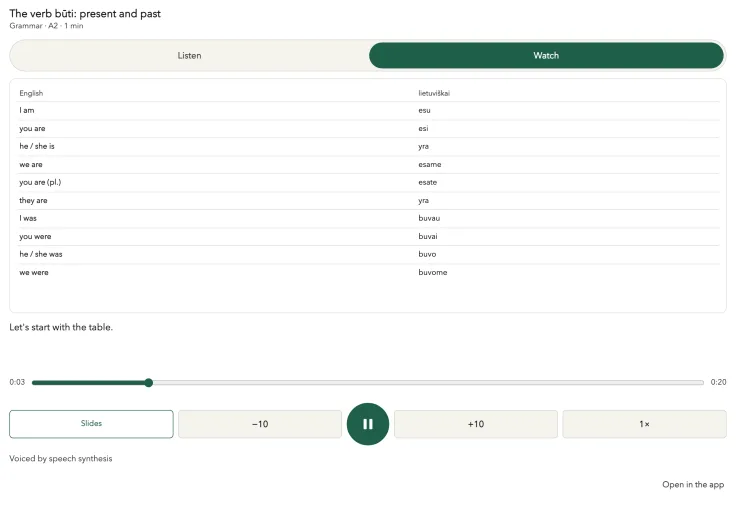
The lesson player on the Lithuanian course: a frame from our test setup, not a screenshot of a live chat. Polish lessons play in the same player.
Where the lesson lives
When it's ready, the lesson opens as a window in the chat (lesson_open) or waits in the Lessons tab of the app — on the web and in Telegram. That makes it easy to prepare ahead:
Prepare 3 lessons for this week: one on cases after “mam”, one on phrases for the doctor, one on talking to a courier at the door. I'll listen on my phone.
The agent keeps up to five unfinished lessons per topic and doesn't push the same problem word more than once a week, so the queue doesn't turn into a pile.
A note on “offline”: there's no file to download. Offline here means the lesson is assembled without you, and you listen to it later, whenever it suits you.
A lesson on your weak spots
The most useful lesson is the one about your own mistakes. With topic: weak_spots the agent takes errors from your quizzes, slow words (word_stats) and corrections from your conversations, and builds a lesson around them.
Make a lesson on my weak spots from the last two weeks: the words I recall slowly and the corrections from my conversations.
If you keep answering slowly on wynagrodzenie or a conversation corrected you twice on zaświadczenie, that's what the lesson will be about.
How much Polish is in a lesson
Volume follows your level:
- A1–A2 — 10 to 20 scenes, up to half of them explanations in English, new phrases spoken more slowly and repeated.
- B1–B2 — more of the lesson in Polish.
- Grammar — always with slides: a table, the rule, an exercise.
Make a B1 lesson on giving opinions: “moim zdaniem”, “zgadzam się”, “to zależy”. Mostly in Polish, explanations in English only where needed.
Those three are real phrases from the course's B1 deck on opinions: moim zdaniem (in my opinion), zgadzam się (I agree), to zależy (it depends). They're useful for the oral part of the B1 exam too; the mock oral exam is in the app's exams tab.
The explanation voice is English or Russian, depending on your interface language — with an English interface, it's English. The Polish phrases are voiced in Polish. All voices are speech synthesis.
Ready-made lessons
You don't have to build everything yourself. For Polish, the Lessons tab already has lessons on the deck topics at A1–A2 and B1: delivery, the office, the doctor, renting a flat, job search and more. A lesson from the agent is for when you need something specific: your text, your mistakes, your situation next week.
Limits
New voicing counts toward the weekly Free limit of 210 new voicings. If it runs out, a new lesson won't be assembled until Monday, when limits reset, or with Pro. Lessons already voiced don't use the limit. Plans and the other limits — in the section hub; all guides — Polish guides.
The words from a lesson are worth saving: ask the agent to add them to your vocabulary, as described in Polish words with an AI agent.
Questions
Can AI make Polish audio lessons?
Yes: with the Talkfirst connector, the agent writes the script and the server assembles it with Polish and English voices, slides and exercises. You listen in the chat or in the app.
How long does it take to build a lesson?
A lesson of about eight scenes with new voicing takes roughly 15 seconds on the server. Scenes that were already voiced come from the cache.
Can I download a lesson?
There is no file to download. The lesson lives in the Lessons tab of the app on the web and in Telegram, and you can listen with the screen off.
Does the lesson check my answers?
No, a lesson doesn't wait for answers. To check yourself, use a quiz or the pronunciation window after the lesson.