 Talkfirst
Short answer. With the Talkfirst connector, Claude or ChatGPT agrees a weekly plan with you and saves it with plan_set: up to 12 weeks ahead, each with a focus and targets. The server counts the fact itself — minutes of your own speech, quizzes, conversations and lectures — so in any new chat the agent sees both the plan and what you did.
Ask any AI chat for a Lithuanian study plan and you get a neat table: week one greetings, week two numbers, week three the shop. The trouble starts next Monday. The chat doesn't know what you did, and in a new conversation the plan is gone. This guide is about a plan the agent can come back to, and about numbers it does not make up.
Start with the profile
The plan only makes sense against a goal. Your profile in Talkfirst (profile) holds:
- your level, as your own estimate from A1 to C2;
- your goal: work, with your profession, or life — travel, moving, socialising, media, an exam;
- a short “about me”;
- a target level and a deadline.
I'm A1, I live in Kaunas and work as a driver. I need Lithuanian A2 for permanent residence. Set my goal to the exam, target level A2, and ask me for the deadline.
The agent updates the profile and, at the start of every later session, reads it together with today(), notes() and plan(). That is why a new chat already knows your level, your goal and your words.
How the weekly plan works
The tools are plan() to read and plan_set(weeks) to write. A plan covers up to 12 weeks ahead, and a week starts on Monday. Each week has a focus — up to 300 characters in plain words — and targets that the server counts by itself:
- minutes of your own speech (
speech_min); - quizzes;
- conversations;
- lectures completed.
The fact for the current week and past weeks is filled in by the server, not by the agent and not by you. So when you open a new chat, the agent sees the plan and the fact side by side and doesn't need to ask what you did.
Days inside a week are not stored. If you want speaking on Tuesday and Thursday and flashcards every evening, say so in the conversation; the plan keeps the week. The agent agrees the plan with you before writing it.
Make a 4-week plan for me. Week 1: talking about myself and my family. Week 2: transport and directions. Week 3: the doctor. Week 4: renting a flat. Twenty minutes of speech a week to start, two quizzes, one conversation a week. Show it to me before saving.
Pace: how far you are from the goal
Once there is a target level and a deadline, the server estimates the pace (pace): roughly how many minutes of speech a week you need to reach the level by the date, how many you are doing now, and whether your plan's limit allows it. The first two weeks after you set the goal are calibration, and the numbers are rough — “about”, not a forecast.
The agent talks about pace only from this field. It won't promise you A2 in a certain number of weeks, and neither do we: how long it takes depends on your hours, the languages you already know and how much Lithuanian is around you.
How is my pace towards A2? Can I fit it into the free plan, or do I need more speaking each week?
On the Today screen of the app the same estimate is a “Pace to …” card.
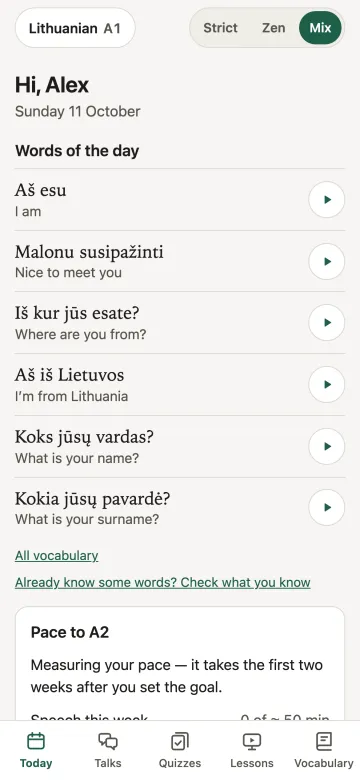
The Today screen of the app in Telegram, Lithuanian A1 with an English interface. A frame from our test setup.
Looking back
progress(days) shows flashcards and reviews, your activity by source and your latest pronunciation attempts.
What did I do in the last 14 days? Where did I fall short of the plan, and what should go into next week's focus?
Next week I'm travelling. Rewrite it: only ten minutes of speech and flashcards every day, no conversations.
Standing wishes: notes
Some things are not a plan but a way of working: explain in English, correct endings after the conversation and not during it, my exam is in spring. These go into notes (notes / notes_set), up to 2000 characters. When you say something like that, the agent offers to save it, and then reads it in every new chat.
Save to my notes: I work evenings as a courier, so practise phrases for the door and the phone. Correct my endings only after the conversation.
If the goal is permanent residence
For permanent residence you usually take the state A2 exam — oral and written parts — and the Constitution test. The app has mock exams for each of them: the A2 oral part, the written part and the Constitution test. On the free plan you get one full mock of each kind every 7 days. Mock exams are not among the targets the server counts, so put them into the week's focus: “Friday: mock oral part”.
I have eight weeks until the exam. Plan the last four around the exam format: one mock oral part a week, the written part every other week, the Constitution test in week 7.
How the exam is built: the A2 exam, the written part and the Constitution exam. The mock exams themselves: A2 mock exam and Constitution test. A plan in four stages without an agent is in how to learn Lithuanian from zero to A2.
Connecting the agent is in the hub of this section; other guides are in Lithuanian guides; the course itself is on the Lithuanian page.
Questions
Can ChatGPT make a Lithuanian study plan?
It can write one, but it doesn't know what you did last week. With the Talkfirst connector the plan is stored in your account and the server fills in the fact, so the agent sees both in every chat.
How long does it take to reach A2 in Lithuanian?
We don't promise a date. The pace estimate tells you roughly how many speaking minutes a week you need for your target date; in the first two weeks it is still calibrating.
Can the plan include the mock exams?
Yes, as part of the week's focus. The A2 oral and written parts and the Constitution test are in the app; on the free plan each full mock is available once every 7 days.