 Talkfirst
Short answer. Tell Claude or ChatGPT with the Talkfirst connector which Lithuanian words and phrases you need, and it writes them into your vocabulary with vocab_add: the word in dictionary form, the meaning in your language and an example. The same entries become flashcards with spaced repetition and quizzes, in the chat, in the browser and in Telegram.
An AI agent is good at finding the words you need: from a message from your landlord, from a delivery shift, from a conversation you just had. What it can't do on its own is keep them. In a new chat the list is gone, and nothing brings a word back after three days. This guide is about giving the agent a place to put words, and what it does with them afterwards.
Why words should live outside the chat
A plain chat can make you a list of twenty Lithuanian phrases. You copy them somewhere, and two weeks later you no longer know which ones you still remember. For Lithuanian this hurts more than for most languages: a word you met as autobusu in Į darbą važiuoju autobusu. comes back next week as autobusas, and without regular review the forms blur together.
With the Talkfirst connector the agent writes each word into your vocabulary. That vocabulary is the same in Claude, in ChatGPT, in the web app and in the Telegram app, and every entry becomes a flashcard with spaced repetition. How to connect it is in the hub of this section.
How the agent writes a word
The tool is vocab_add. One call takes up to 200 entries, and each has a term in Lithuanian, a meaning in your explanation language, an example, a level and a kind. The entry goes into the vocabulary and into flashcards at once; duplicates are skipped, so you can safely ask to add a list that partly overlaps with what you have.
There are two kinds of entry:
- A chunk — a word or a short expression of up to about five words: bilietų kasa (ticket office), Pasukite į kairę (Turn left). Chunks go into flashcards and quizzes.
- A formulation — a whole ready sentence you want to be able to say, for example Lietuvoje gyvenu jau dvejus metus. (I've been living in Lithuania for two years.) Formulations don't go into quizzes; instead, the conversation partner in your talks creates a reason for you to say them.
Before adding, the agent reads the rules in docs("vocab"). One entry is one word in dictionary form or one whole phrase. If you said Į darbą važiuoju autobusu., the entry is važiuoti (to go by transport), and your sentence becomes its example. Lists are split into separate entries, and a grammar rule is not an entry at all — that belongs in a lecture.
Where the words come from
From your own life
The best words are the ones you will need this week. Paste a message, describe a situation at work, or name the place you are going to, and ask the agent to pull out the phrases.
I deliver food in Vilnius in the evenings. Add to my vocabulary the phrases I need at the door: Koks durų kodas?, Esu prie durų, Palaukite minutėlę, Užsakymas jums. Meanings in English, one short example each.
The agent writes four chunks with vocab_add, each with the meaning and an example. There is also a free scene, “At the customer's door”, where you can try phrases like these out loud.
Here is a message from my landlord: … Find the words and phrases I probably don't know at A2, show me the list first, and add only the ones I confirm.
From your conversations
After a voice conversation in Talkfirst you get a review: corrections, a “Say it better” version and new words. Each of them has a “+” button that puts it straight into your vocabulary. The agent can then work with these words like any others.
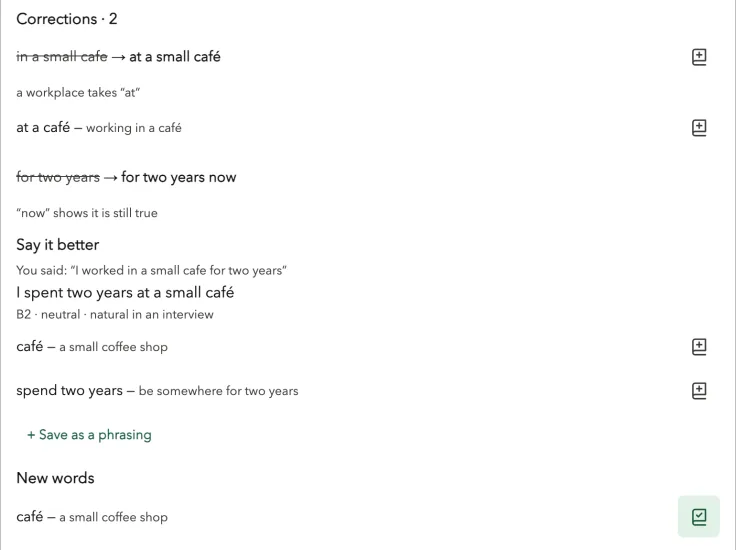
The review after a conversation on the English course; the window is the same for Lithuanian. A frame from our test setup, not a screenshot of a live chat.
From topic decks
The course has ready decks by level and topic: meeting people, transport, delivery and taxi, at the doctor, renting a flat, jobs and work, and more.
Show me the A2 topic decks. I need something for the oral exam and for renting a flat.
The agent reads the list with topics() and suggests where to start.
A sentence for the exam
Save this as a phrasing, not a flashcard: Lietuvoje gyvenu jau dvejus metus. I want to say it in the oral A2 exam when they ask how long I've lived here.
The agent adds it as a formulation. Questions you can expect in the oral part are in A2 speaking questions.
Review: flashcards and quizzes
Words come back on a schedule. The agent asks what is due with srs_due and records your answers with srs_review, so the next date depends on how well you knew the word.
What's due for review today? Go through it with me, one card at a time.
Quizzes are started with quiz_start. Types: recognise (pick the meaning in your language), recall (from your language to Lithuanian), listening, say it out loud, and “say it in Lithuanian”, where you see the meaning and answer by voice from memory. The source can be what's due, your weak words, new words, a topic, or an exact list of terms.
Quiz me on listening with my weak words. Then repeat only the ones I got wrong and save that quiz for Friday.
The repeat uses only_wrong, and the saved quiz goes to quiz_save; later the agent finds it in quizzes. If you don't know where you stand, ask for a placement check.
Which words am I still not recalling confidently? And how am I doing with važiuoti?
The agent filters with vocab_list and looks up one word with word_stats: its status, skills from 0 to 2 and your median answer time per skill. Treat it as a reason to talk, not a verdict.
Cleaning up the list
- “Not now” — the agent postpones the card with
defer_card. - “I don't want to learn this at all” —
skip_card. - “I already know it” —
mark_knownat one of five levels: I recognise it, I recall it, I catch it by ear, I pronounce it, I use it. - “Go through the list with me” —
calibrate: the agent walks you through the words and you say what you know.
In the app the vocabulary is on the Vocabulary tab, and you can remove a word there. There is no “add your own word” button in the app: your own words come in through the agent or from a conversation review. The app also has three modes — Strict, Zen and Mix; Zen is for days when you want practice without pressure.
What to read next
Words become speech when you say them: pronunciation is in checking Lithuanian pronunciation with an agent. Ready lists to start from: first Lithuanian phrases and Lithuanian for work. All guides are in Lithuanian guides, and the app itself is on the Lithuanian course page.
Questions
Can ChatGPT or Claude make Lithuanian flashcards?
They can make a list, but they don't keep it or bring words back on a schedule. With the Talkfirst connector the agent writes the words into your vocabulary, and they become flashcards with spaced repetition and quizzes.
Do I still need Anki?
Not for words you learn with the agent: the flashcards and the review schedule are already in Talkfirst, in the chat and on your phone. If you have an old Anki deck, you can paste words from it and ask the agent to add them.
How many words can the agent add at once?
Up to 200 entries in one call. Duplicates are skipped. In practice a short list you actually need this week works better than a long one.
Why does the agent change my word before saving it?
An entry is saved in dictionary form, and the form you used goes into the example. That way the different forms of one Lithuanian word don't turn into separate flashcards.