 Talkfirst
Short answer. With the Talkfirst connector, Claude opens a recording window in the chat: you say a Lithuanian phrase and get an overall score out of 100 and a score for each word from speech recognition. The agent then explains the one or two main mistakes in your language. It checks words, not individual sounds or intonation, and the scores are automatic and can be wrong.
Lithuanian is mostly read the way it is written, but saying it is another matter: long and short vowels, ė, š, ž, č, and a stress that moves. In an AI chat's voice mode none of this gets noticed. The assistant is built to understand accented speech, so it answers what you meant and moves on. This guide is about a separate check that shows which word did not come through, and about what the agent does with that.
The pronunciation window
The tool is practice_phrase. It opens a recording window right in the chat, in Claude on the web or in the desktop app. You can call it three ways:
- without arguments — the next phrase from your deck;
- with
text— any phrase you want to practise; - with
card_id— one specific flashcard.
In the window there is a Reference button to hear the phrase first and a Record button. The voice is speech synthesis, not a recorded native speaker.
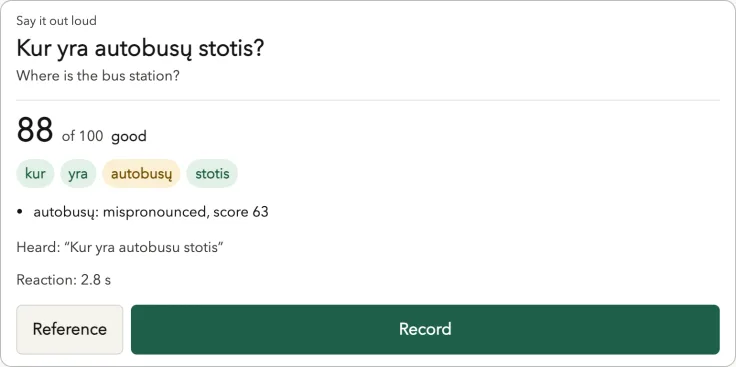
The pronunciation window with the phrase “Kur yra autobusų stotis?” (Where is the bus station?). A frame from our test setup, not a screenshot of a live chat.
What the result shows
In the frame above the overall score is 88 out of 100. Each word has its own score, and a word that came out unclear is highlighted: autobusų — mispronounced, score 63. Under the words is “Heard”, what the recognition actually understood: Kur yra autobusu stotis, without the long ending. There is also a reaction time — how long you took before you started speaking.
Be clear about what this is. It is a word-level assessment based on speech recognition. It tells you which word was not recognised as the one intended, not which sound inside it was wrong, and it does not grade intonation. Scores are automatic and can be wrong. As a trainer for many repetitions it works well; as a phonetician who fixes your accent from scratch it does not.
After each attempt the agent explains one or two main mistakes in plain words, in your explanation language. If the recognition did not hear Lithuanian at all, there is no score, and the agent asks you to record again.
Prompts for the window
A phrase you need this week
Give me a pronunciation window for: Ar šis autobusas važiuoja į centrą? I'll ask the driver tomorrow.
The agent calls practice_phrase with text, waits for your result and tells you what to change.
Go through your deck
Let's practise pronunciation from my deck. Next phrase, then the one after it, until I say stop.
Without arguments the window takes the next phrase from your deck, so you don't have to type anything.
From memory, not from the screen
Recall mode for my delivery phrases: show only the English, I'll say Koks durų kodas? and the others from memory.
With recall=true the window shows only the meaning. You say the phrase from memory, and the original opens after the recording. After such an attempt the agent counts the flashcard with srs_review and the suggested grade, so speaking from memory is also your review.
Several phrases in a row
A “say it from memory” quiz on five phrases for the doctor, including Ką jums skauda? and Kada galiu ateiti?
This is quiz_start(type="say"). At the end you see for each phrase whether it was recognised, the score, the reaction time and a hint when a phrase can be marked as known.
For the oral exam
I'm preparing for the oral A2 exam. Give me a window for Lietuvoje gyvenu jau dvejus metus. and tell me only the main problem.
Questions to practise with are in A2 speaking questions, and the mock oral exam with a timer is in the app, on the A2 exam page.
Pauses in conversation
A single phrase is one thing; a conversation is where you hesitate. In Talkfirst voice conversations the recognition returns the time of each word. Any pause of 0.4 seconds or more between words is recorded together with the word it came before, and so is your “thinking time” before the first word.
Words you often stumble before show up in today() as pauses_summary. The conversation partner then weaves them into your next conversations, so you get to say them again in a new context, not just in a drill.
Which words do I pause before most often? Make a quiz on them and then give me a window for the worst one.
On your phone
In the Claude mobile apps connector windows have no microphone. The text tools still work there, but for recording use the Talkfirst app in the browser or in Telegram; the window itself offers “Open in browser”. When you have recorded, write “done” in the chat: the agent takes the result from progress and carries on from there.
The same exercises exist in the app without the agent. How everything fits together is in the Talkfirst app, and how to connect the connector is in the hub of this section. All guides: Lithuanian guides; the course itself: Talkfirst for Lithuanian.
Questions
Can AI check my Lithuanian pronunciation?
It can tell you which words were recognised and which were not, with a score for each word. It does not analyse individual sounds or intonation, and automatic scores can be wrong, so treat them as a guide for practice.
Why does ChatGPT voice mode say my pronunciation is fine?
Voice mode tries to understand you, not to grade you. It answers the meaning it understood and does not show the words it had to guess. A separate word-by-word check shows them.
Does the pronunciation window work in the Claude mobile app?
No: connector windows in the Claude mobile apps have no microphone. Record in the Talkfirst app in the browser or in Telegram, then write “done” in the chat.
Is pronunciation practice free?
Recording uses voice minutes. The free plan has 35 voice minutes a week, which reset on Monday; Pro has 140.